Facts About the Flap-Necked Chameleon
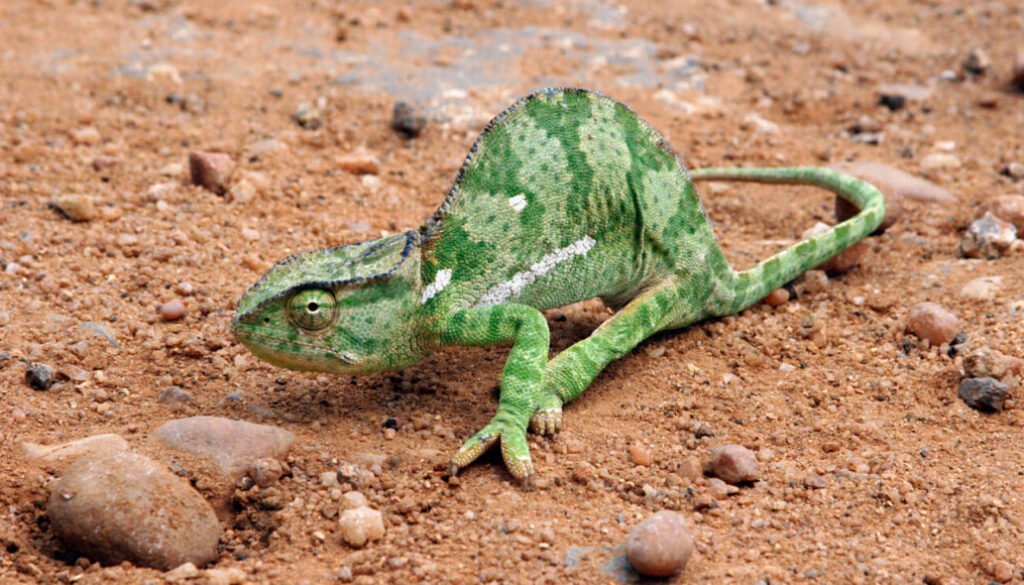
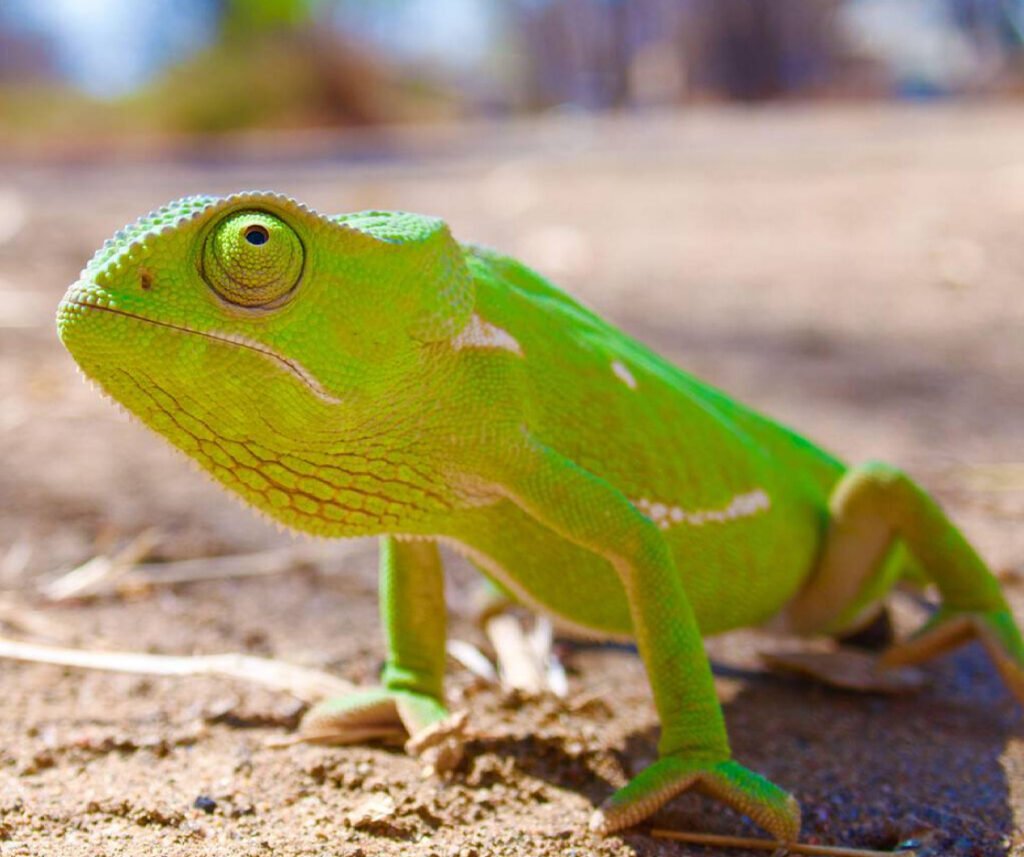
When discussing facts about the flap-necked chameleon, one must start with the physical trait that gives the animal its name. Located at the back of its head are two large, moveable lobes or “flaps” of skin. These are not merely decorative; when the chameleon feels threatened or needs to assert dominance, it raises these flaps to make its head appear significantly larger and more intimidating to predators or rivals.
The body of the Chamaeleo dilepis is typically a vibrant green, but it possesses a complex array of chromatophores—specialized pigment cells. These allow the lizard to shift colors based on temperature, light, and emotional state. Contrary to popular belief, they don’t change color solely to “hide.” Instead, a darkened skin tone often indicates stress or a desire to absorb heat from the sun.
Essential Facts About the Flap-Necked Chameleon
- Common Name: Flap-necked Chameleon
- Scientific Name: Chamaeleo dilepis
- Type: Reptile
- Diet: Carnivore (primarily Insectivorous)
- Average Life Span in the Wild: 5 to 8 years
- Size (Head and Body): 10 to 14 inches (25 to 35 cm)
- Weight: 4 to 15 ounces (approx. 100 to 400 grams
Habitat and Distribution
The flap-necked chameleon is one of the most widespread chameleon species in Africa. Its range extends from the tropical forests of East Africa down through the humid savannas of Southern Africa. Unlike some of its cousins that are restricted to high-altitude rainforests, the flap-necked chameleon is highly adaptable. It can be found in coastal thickets, woodlands, and even suburban gardens, provided there is enough vegetation to provide cover and a steady supply of insects.
The Art of the Hunt: Diet and Specialized Tools
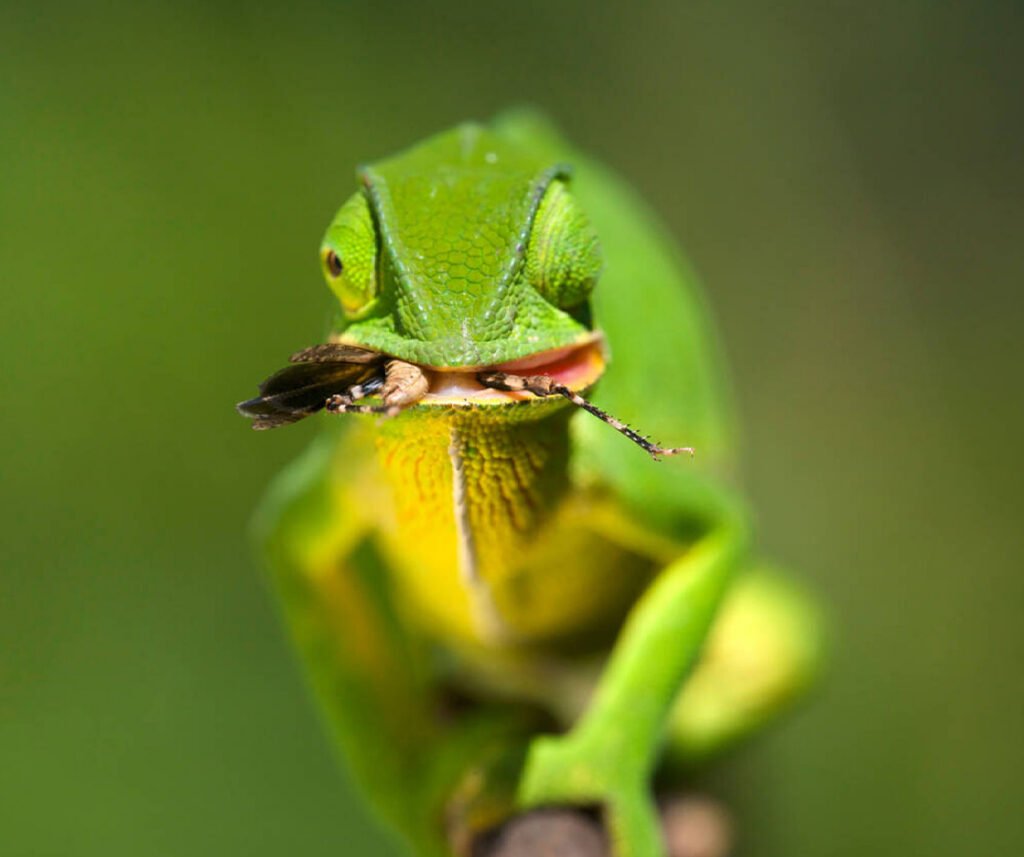
The dietary facts about the flap-necked chameleon highlight its role as a precision hunter. As a primary insectivore, it feeds on a variety of invertebrates including grasshoppers, beetles, and crickets. Occasionally, larger individuals have been known to consume smaller lizards or even fledgling birds.
To capture such agile prey, the chameleon utilizes a “ballistic” tongue. This organ can be extended to lengths exceeding its own body size in a fraction of a second. The tip of the tongue is covered in a thick, sticky mucus that acts like biological Velcro, snagging the insect before the prey even realizes it is being targeted. This mechanism is powered by a complex set of accelerator muscles that store potential energy, much like a drawn bow.
Vision and Sensory Perception
One of the most fascinating facts about the flap-necked chameleon is its eyesight. Their eyes are housed in cone-shaped turrets that can move independently of one another. This allows the chameleon to achieve a 360-degree field of vision. It can watch a hawk circling above with one eye while simultaneously tracking a grasshopper on a nearby leaf with the other.
Once prey is detected, both eyes lock forward to provide binocular vision, giving the chameleon the depth perception necessary to calculate the exact distance for its tongue strike. This “dual-tracking” capability makes them nearly impossible to surprise in their natural habitat.
Behavioral Traits and Social Structure
These reptiles are famously solitary. Outside of the mating season, a flap-necked chameleon views any other member of its species as a competitor for resources. They are highly territorial and will use a display of color changes, body puffing, and the eponymous neck flaps to ward off intruders.
When threatened by a predator, such as a boomslang or a bird of prey, the chameleon employs a “leaf-mimic” walk. It moves with a jerky, back-and-forth motion that simulates a leaf fluttering in the wind. If this camouflage fails, it may hiss loudly, open its mouth to reveal a bright yellow or orange interior, and attempt to bite.
Reproduction and Life Cycle
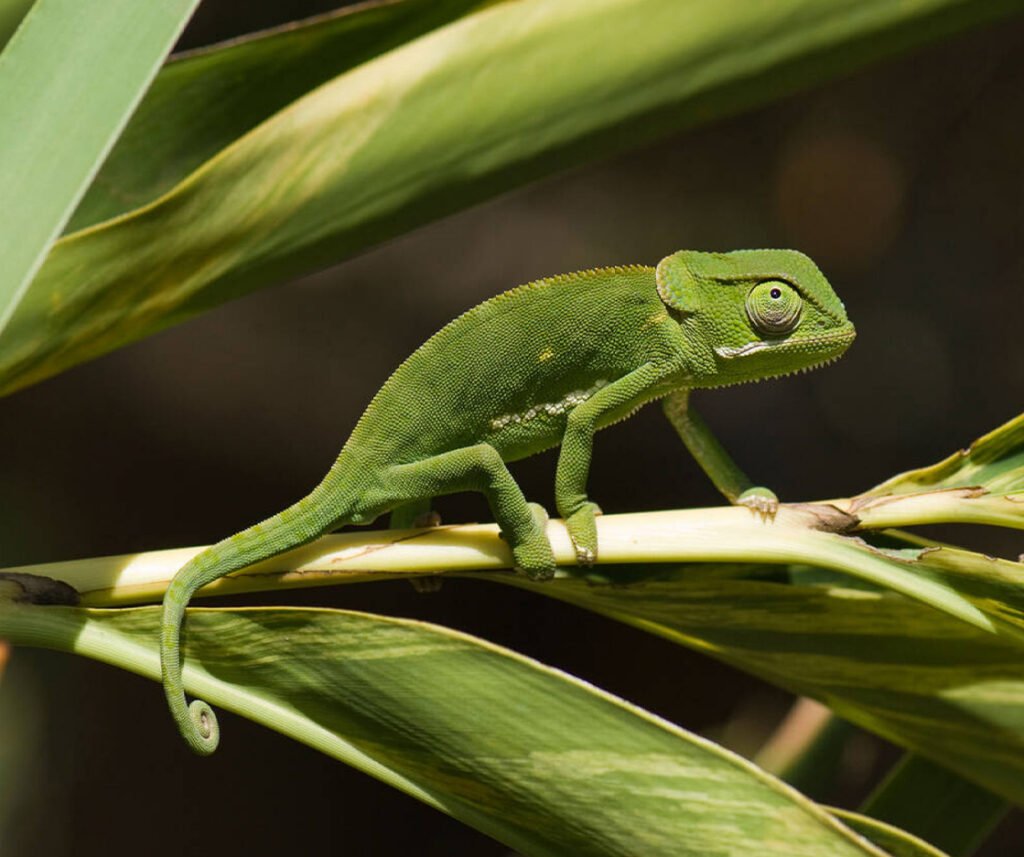
Mating usually occurs during the warm, wet summer months. After a successful mating, the female becomes significantly more aggressive and will develop dark, intense coloration to signal to males that she is no longer receptive.
One of the most critical facts about the flap-necked chameleon regarding its life cycle is its reproductive method. The female is oviparous, meaning she lays eggs. She will descend from the safety of the trees to the ground, where she digs a deep burrow in the moist soil. A single clutch can contain anywhere from 25 to 50 eggs. After burying them, she returns to the canopy, leaving the eggs to incubate for nearly a year. When the hatchlings emerge, they are fully independent and must immediately begin hunting to survive.
Conservation and Environmental Impact
Currently, the flap-necked chameleon is not listed as endangered, largely due to its wide distribution. However, they face ongoing threats from habitat loss and the illegal pet trade. Because they are slow-moving and rely on camouflage, they are often victims of brush fires and road traffic.
Furthermore, the introduction of pesticides in agricultural areas can decimate their food source. Maintaining a healthy population of these chameleons is vital for the ecosystem, as they act as a natural pest control, keeping insect populations in check.