
Facts About the Black Rhino: The Guide to an Iconic Survivor

One of the most surprising facts about the black rhino is that they are actually grey. In fact, they are roughly the same color as the “white” rhino. The naming convention has nothing to do with pigmentation and everything to do with a linguistic mix-up.
The white rhino’s name likely comes from the Dutch word “wijd,” meaning wide, referring to its broad, square lip. English speakers misheard this as “white.” Consequently, the other species was dubbed “black” simply to tell them apart. If you look at them side-by-side, you’ll notice the black rhino is generally smaller and carries its head higher.
Black Rhino: Fast Facts
-
Common Name: Black Rhinoceros (also known as the Hook-lipped Rhino)
-
Scientific Name: Diceros bicornis
-
Type: Mammal
-
Diet: Herbivore (Browser)
-
Average Life Span In The Wild: 35 to 50 years
-
Size: Head and body: 2.8 to 3.8 meters (9.2 to 12.5 feet); Height at shoulder: 1.3 to 1.8 meters
-
Weight: 800 to 1,400 kg (1,760 to 3,080 lbs)
A Prehensile Lip Built for Precision
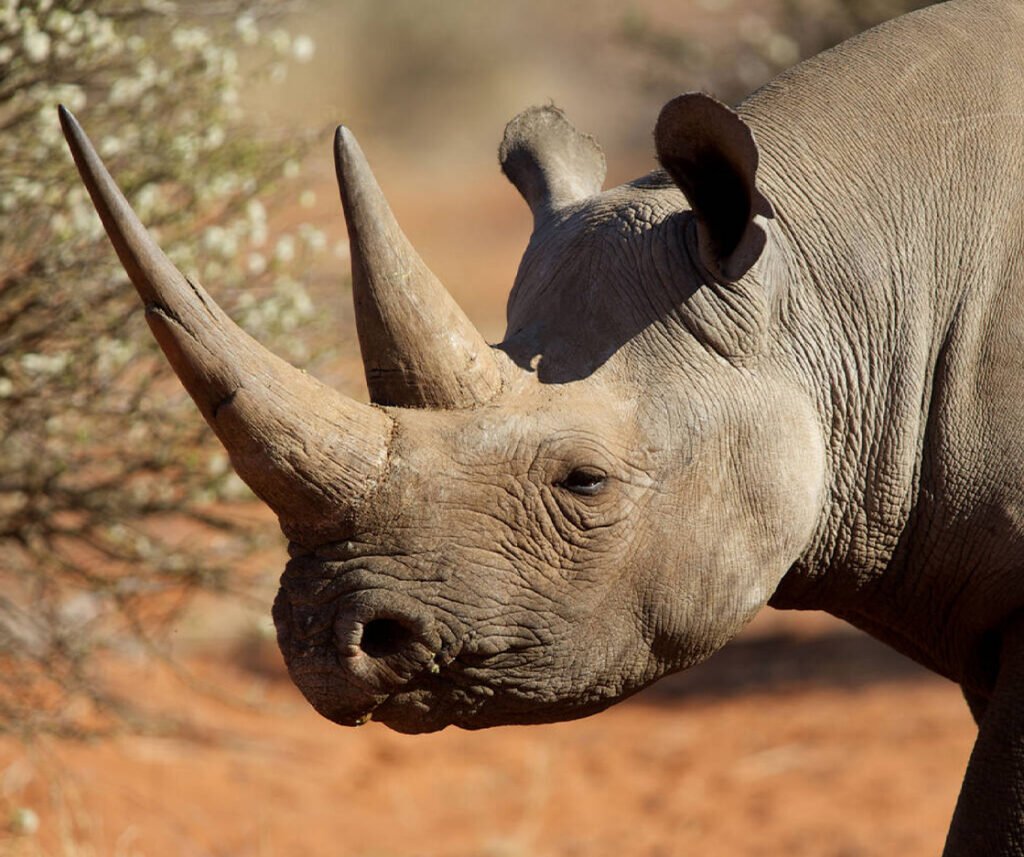
Unlike the white rhino, which acts like a giant lawnmower grazing on grass, the black rhino is a “browser.” One of the key facts about the black rhino is its specialized upper lip. It is triangular and prehensile (capable of grasping), much like a short elephant trunk.
This lip allows them to pluck leaves and fruit from woody branches and navigate through thickets of acacia thorns with surgical precision. They are the gourmets of the savannah, selecting specific high-protein plants that other herbivores might ignore.
The Double-Horned Defender
The most iconic feature of the species is undoubtedly its horns. Most black rhinos have two horns, though occasionally a small third horn may develop. These aren’t made of bone, but of keratin—the same protein found in your hair and fingernails.
The front (anterior) horn is usually the larger of the two, often reaching lengths of 20 inches, though some have been recorded at nearly 5 feet. These horns are vital tools used for defense, digging for water, and breaking branches during feeding. Tragically, the demand for these horns in illegal markets remains the primary threat to their survival.
Surprising Speed and Agility
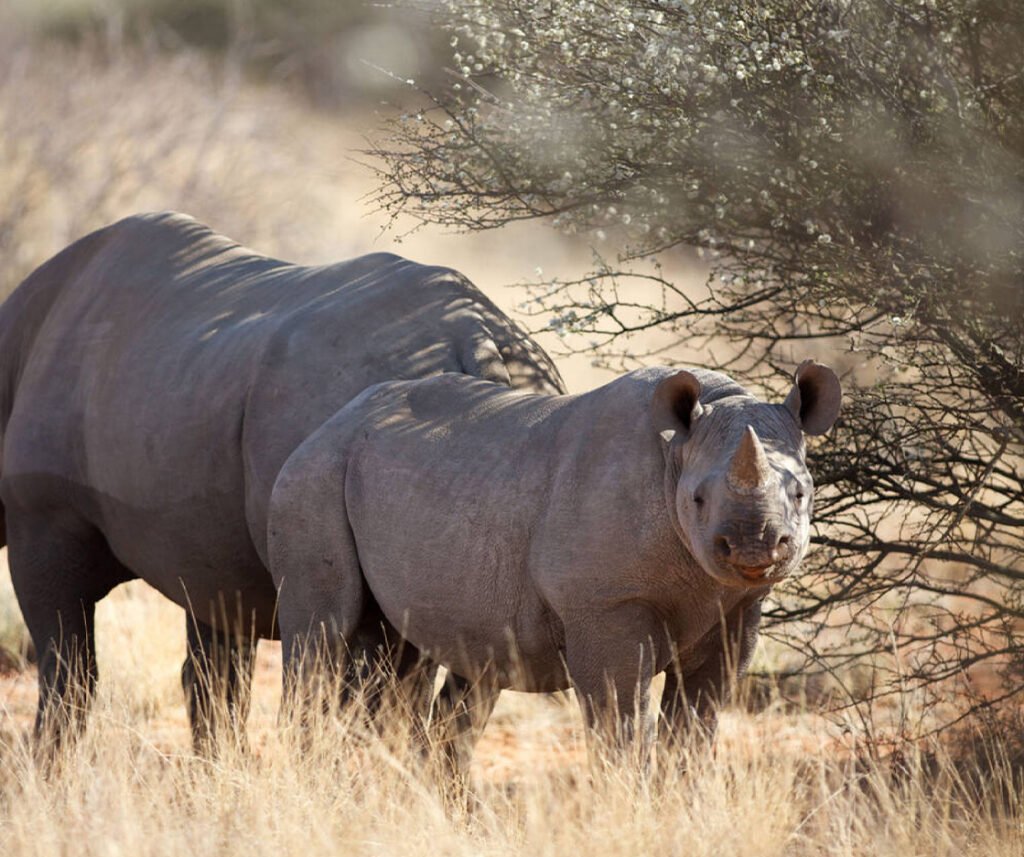
Don’t let their tank-like appearance fool you. Among the most impressive facts about the black rhino is their sheer athleticism. Despite weighing over 3,000 pounds, a black rhino can charge at speeds of up to 35 miles per hour.
They are also incredibly agile for their size, capable of turning on a dime mid-charge. This explosiveness is a defense mechanism; because they have relatively poor eyesight, they tend to “charge first and ask questions later” if they perceive a threat through scent or sound.
A Range of Resilient Habitats
While we often associate them with open plains, the black rhino is remarkably adaptable. They inhabit a range of environments across eastern and southern Africa, including:
-
Deserts: Notably the Kunene region of Namibia.
-
Woodlands: Where food is abundant.
-
Savannahs: Their most traditional home.
-
Mountain forests: Finding refuge in higher altitudes.
The Solitary Socialite
Unlike the more gregarious white rhino, black rhinos are generally solitary. However, the idea that they are “loners” is a bit of a stretch. While they don’t move in herds, they have complex social structures. Mothers and calves stay together for up to three years, and “clans” often share communal water holes or salt licks.
Communication Through Scent
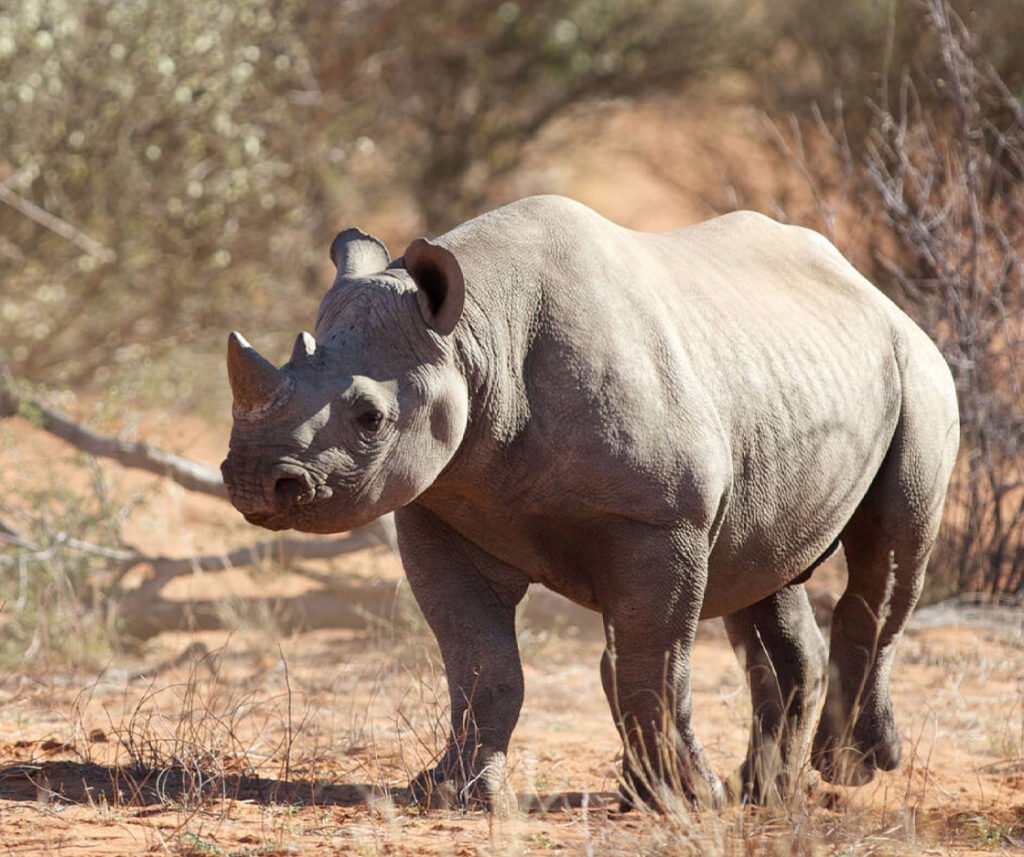
When you can’t see very well, you rely on your nose. Black rhinos live in a “world of smells.” They use “middens”—communal dung heaps—as a sort of neighborhood bulletin board. By smelling the dung of another rhino, they can determine the individual’s age, sex, and reproductive status. It is a primitive but highly effective version of social media.
The Relationship with the Oxpecker
If you see a black rhino, you’ll likely see a small bird perched on its back. This is the Red-billed Oxpecker. This symbiotic relationship is one of the most fascinating facts about the black rhino. The birds eat ticks and parasites off the rhino’s skin. In exchange for the snack, the birds act as an early warning system, screaming loudly when they sense approaching danger, which is why the Swahili name for the bird translates to “the rhino’s guard.”
Reproductive Rhythms
A female black rhino reaches sexual maturity around 4 to 7 years of age, while males take a bit longer, usually 7 to 10 years. The gestation period is a long 15 to 16 months, resulting in a single calf. Because the inter-birth interval is usually 2 to 4 years, population recovery is a slow and delicate process.
The Critical Conservation Status
We cannot discuss facts about the black rhino without addressing their vulnerability. In the 20th century, their populations plummeted by 98% due to poaching and habitat loss. At their lowest point in the 1990s, only about 2,500 remained in the wild.
Thanks to aggressive conservation efforts, those numbers have rebounded to over 6,000 today. However, they remain “Critically Endangered.” Wildlife corridors, armed anti-poaching units, and community-led conservation are the only reasons this species still walks the earth.