How Do Elephants Communicate Through the Ground?
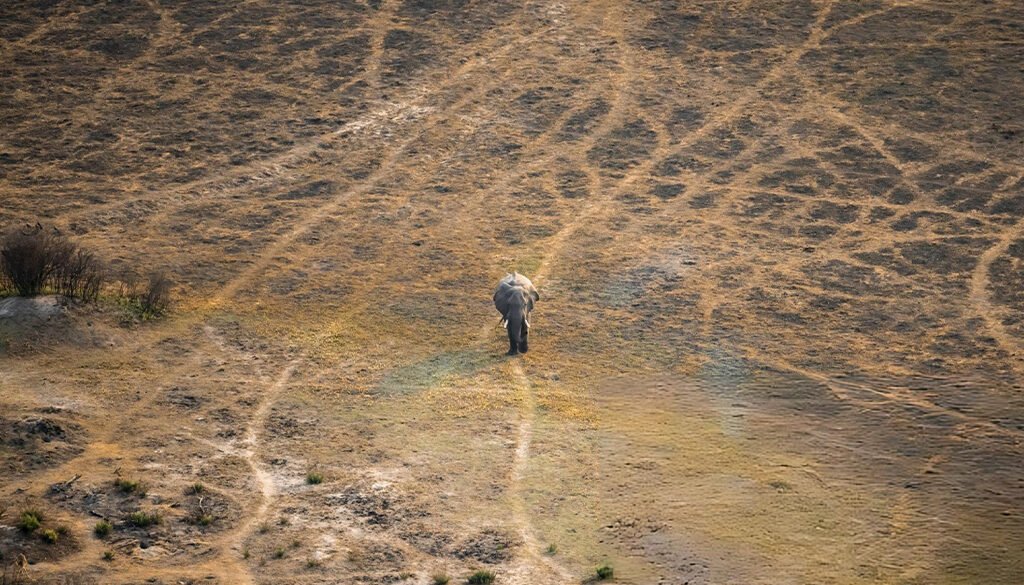
The fundamental answer to how do elephants communicate over vast distances lies deep beneath the earth’s surface. Through a powerful combination of low-frequency infrasound and ground-based seismic vibrations, these gentle giants send long-range signals through the soil itself. They do not just hear with their ears—they feel messages through their feet, legs, and trunks.
The Mechanics of Infrasound
At the core of underground signaling is infrasound – sound waves that fall below the lower limit of human hearing, typically below 20 Hertz (Hz). Humans hear frequencies between 20 Hz and 20,000 Hz. Elephants produce powerful vocalizations that drop down to 14 Hz or lower.
These low-frequency calls, often called “rumbles,” are generated in the elephant’s massive vocal cords. Because lower frequencies feature longer wavelengths, they do not scatter or degrade easily when encountering trees, brush, or atmospheric turbulence.
While air-transmitted infrasound can travel up to 6 miles (10 kilometers), a substantial portion of the acoustic energy generated during a low rumble couples directly with the earth. When an elephant produces a low-frequency vocalization, the physical vibration passes through its body into the ground, transforming acoustic waves into surface seismic waves (Rayleigh waves).
Anatomical Innovations: Nature’s Built-In Seismometers
The physical structure of an elephant’s foot is engineered for seismic transmission and reception.
Anatomical Feature | Structural Role | Functional Benefit |
Digital Cushion | Large fat pad located at the heel | Dampens heavy impact while conducting micro-vibrations directly to nerve centers. |
Pacinian Corpuscles | High-density mechanoreceptors in toe tips | Detects micro-displacement in soil caused by incoming Rayleigh waves. |
Columnar Limb Bones | Vertical, dense bone arrangement | Minimal angle joints allow efficient mechanical transfer of ground vibrations up to the skull. |
Subcutaneous Trunk Nerve Networks | Dense tactile nerve endings in the trunk tip | Resting the trunk on the ground creates a secondary, highly sensitive seismic antenna. |
When an incoming seismic signal arrives, an elephant will often freeze in place. This behavior, known as “seismic listening,” involves shifting weight onto three legs, pressing the broad front feet firmly against the soil, and sometimes placing the tip of the trunk onto the dirt to increase contact area.
Contexts of Underground Messages
Elephants rely on seismic signaling for critical survival situations where visual or standard vocal cues are impossible:
-
Predator Warnings: A herd encountering lions or poachers will stamp the ground or emit a sharp panic rumble. Surrounding herds miles away pick up the seismic shockwave and immediately assume a defensive ring formation.
-
Mating Calls: Estrus females emit powerful, low-frequency rumbles that travel for miles through the soil, signaling their location and receptive state to solitary bulls scattered across a landscape.
-
Resource Coordination: Matriarchs use ground signals to coordinate movement toward water holes, mineral licks, or fresh grazing land without revealing their position to competitors.
-
Distress Signals: Separated calves or injured herd members send high-amplitude seismic pulses that alert family members across vast distances.
Atmospheric Windows & Environmental Factors
Seismic communication relies heavily on environmental conditions. During late afternoons, warm ground temperatures create atmospheric turbulence that disrupts airborne sound waves. However, the ground remains an extraordinarily stable medium for wave propagation.
During cool desert nights, inversions in air temperature allow both airborne and seismic waves to travel maximum distances. Elephants capitalize on these atmospheric windows, conducting the majority of their long-distance seismic exchanges during dawn and dusk.
Understanding the biomechanics behind how these creatures navigate their environment reveals an intricate natural communications grid beneath our feet—proving that earth itself serves as a living network for wildlife.