Facts About the Kori Bustard
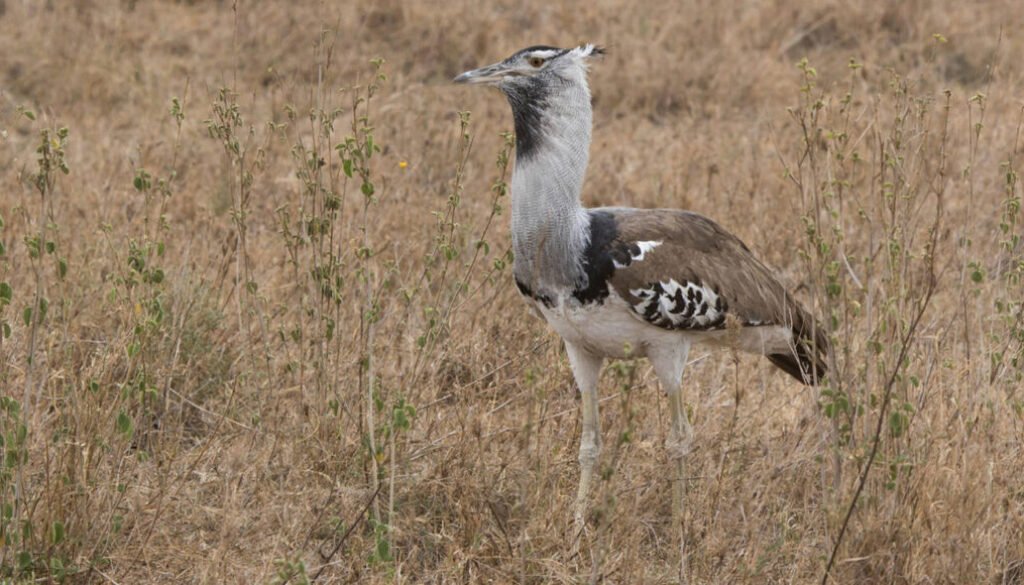
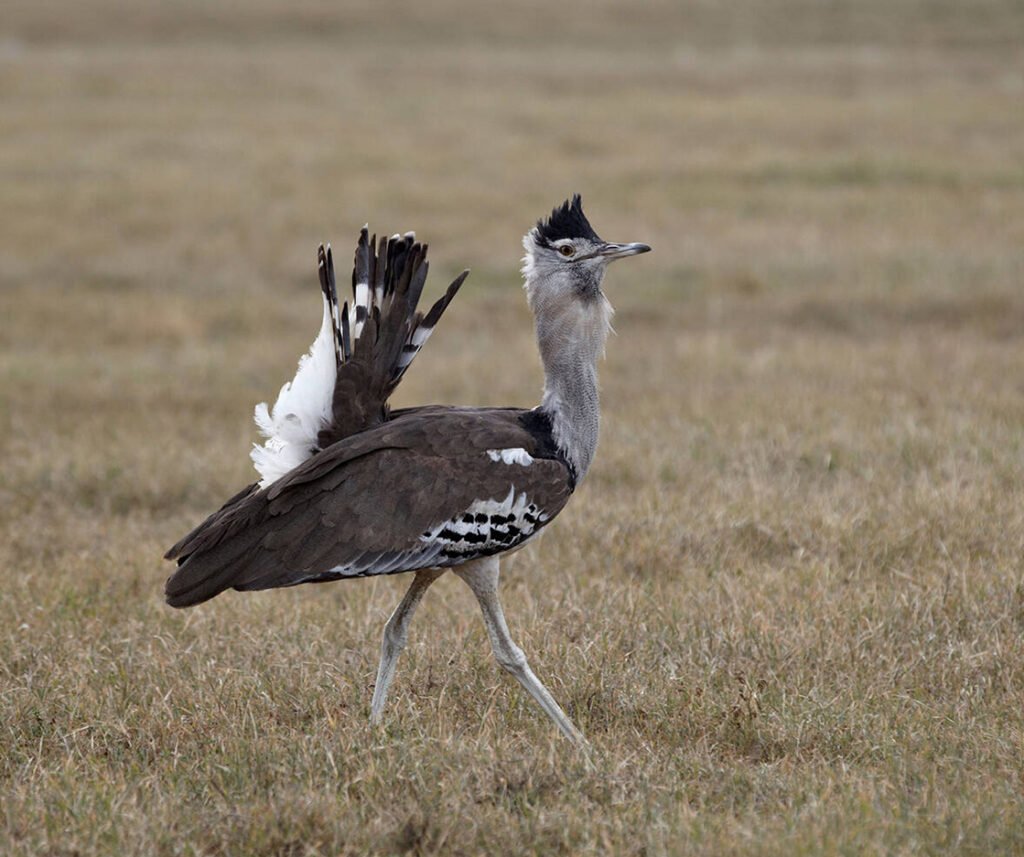
The most famous of all facts about the Kori Bustard is its sheer mass. While ostriches and emus are significantly heavier, they are grounded. Among birds that can actually take to the air, the Kori Bustard (specifically the male) holds the title for the heaviest.
Flying for a Kori Bustard is an energy-intensive endeavor. They prefer to stay on the ground and will usually only fly if they are in immediate danger. When they do take off, it is a sight to behold—a massive, slow-flapping ascent that looks like it should be aerodynamically impossible.
Essential Facts About the Kori Bustard
- Common Name: Kori Bustard
-
Scientific Name: Ardeotis kori
-
Type: Bird
-
Diet: Omnivore
-
Average Life Span in the Wild: 26 to 28 years
-
Size (Head and Body): 2.3 to 4.3 feet
-
Weight: 15 to 42 pounds
A Tale of Two Regions
There are actually two distinct subspecies of the Kori Bustard, separated by thousands of miles.
-
Ardeotis kori kori is found in Southern Africa (Botswana, Namibia, South Africa).
-
Ardeotis kori struthiunculus is found in East Africa (Ethiopia, Kenya, Tanzania).
Interestingly, there is no “bridge” population between these two groups. They have evolved in isolation from one another, though they remain remarkably similar in behavior and appearance.
The “Bustard” Name Origin
The name “Bustard” comes from the Old French word bistarda, which stems from the Latin words avis tarda, meaning “slow bird.” This is a bit of a misnomer. While they walk slowly and deliberately to avoid detection, they are incredibly powerful runners and, as mentioned, capable of flight when necessary.
An Opportunistic Omnivore
When researching facts about the Kori Bustard, their diet reveals a lot about their survival strategy. They aren’t picky eaters. As omnivores, they consume:
-
Insects: Grasshoppers, locusts, and beetles are favorites.
-
Small Vertebrates: They have been known to eat lizards, chameleons, and even small rodents.
-
Plant Matter: Seeds, berries, and roots provide essential nutrients during the dry season.
-
Acacia Gum: They are one of the few birds known to eat the resin from acacia trees.
The Magnificent Mating Display
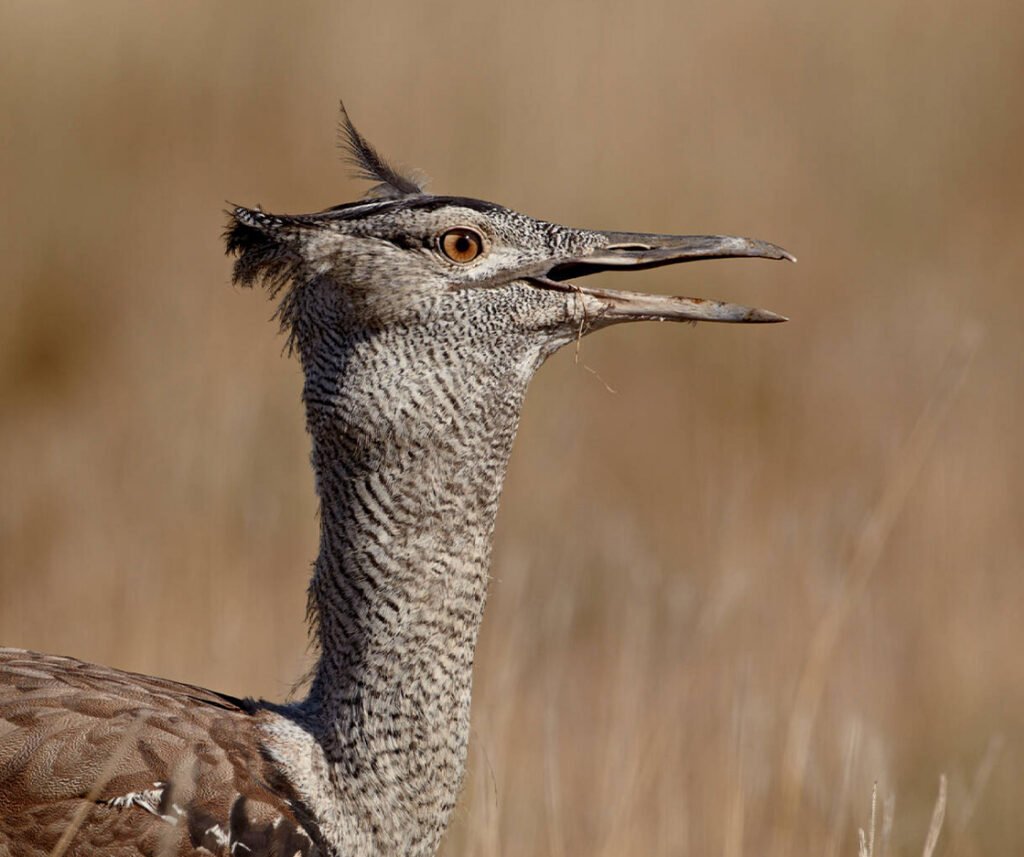
The Kori Bustard is a practitioner of “lekking.” During the breeding season, males congregate in a specific area to perform for females. A male Kori Bustard will puff out his neck feathers to nearly double his size, inflate his esophagus, fanning his tail, and emit a low-frequency booming sound that can carry for miles. It is a dramatic, “all-or-nothing” display of fitness.
Social Distancing Experts
Unlike many African birds that travel in large, noisy flocks, Kori Bustards are generally solitary or found in small groups. You might see a mother with her chicks or a pair during mating season, but for the most part, they prefer their own company. This solitary nature helps them remain inconspicuous to predators like lions and leopards in the tall grass.
A Unique Relationship with the Bee-eater
One of the most charming facts about the Kori Bustard is its symbiotic relationship with the Northern Carmine Bee-eater. These small, brightly colored birds are often seen riding on the backs of Kori Bustards.
As the heavy Kori Bustard walks through the grass, it flushes out insects. The Bee-eaters then dive off the “mobile perch” to catch the insects in mid-air. The Kori Bustard doesn’t seem to mind the hitchhikers; in fact, the Bee-eaters may act as an early warning system for approaching predators
Water Intake: The Sucking Method
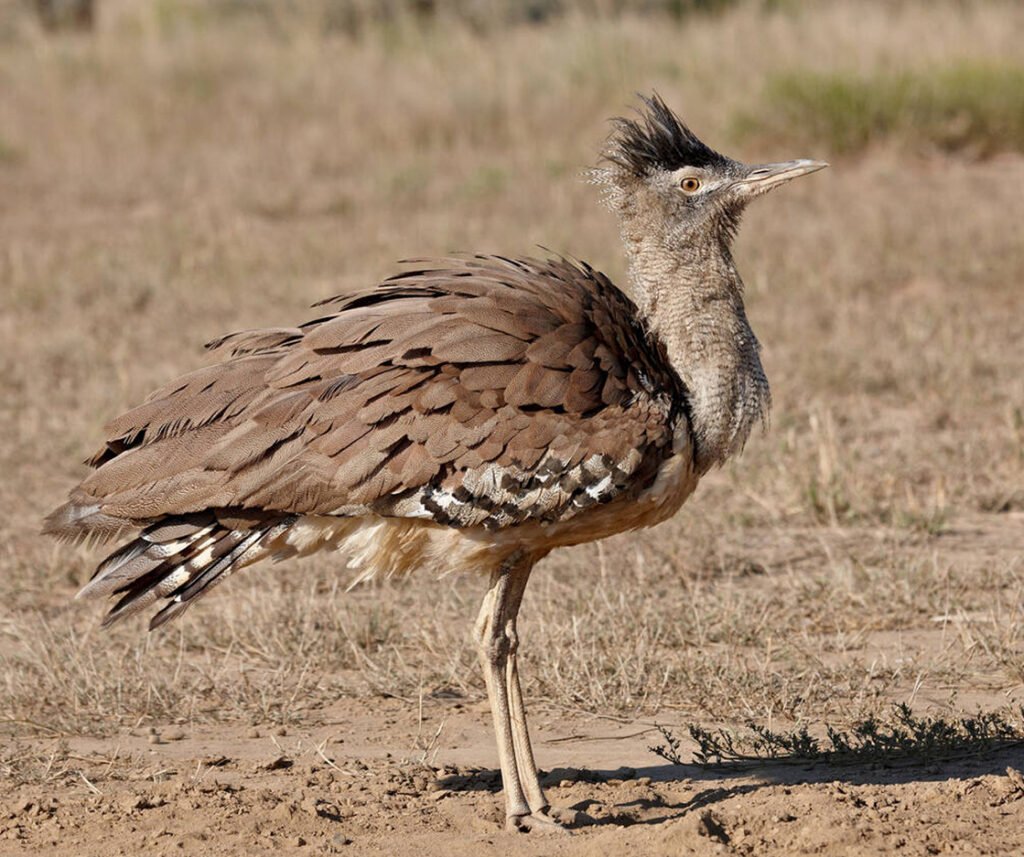
Most birds drink by scooping water into their lower mandibles and then tilting their heads back to let gravity do the work. The Kori Bustard is different. It is one of the few bird species capable of “sucking” up water, allowing it to drink more efficiently in arid environments where water sources might be shallow or scarce.
Nesting on the Edge
Kori Bustards do not build traditional nests in trees. Instead, the female scrapes a shallow hollow directly into the ground, usually near a tuft of grass or a bush for camouflage.
Because the eggs are on the ground, they are highly vulnerable. The mother is incredibly protective and relies on her cryptic (camouflaged) plumage to blend into the earth, staying perfectly still to avoid being spotted by egg-hungry predators like jackals or hyenas.
Conservation Status and Threats
Currently, the Kori Bustard is listed as “Near Threatened” by the IUCN. While they are still spotted frequently in protected national parks, their numbers are declining. The primary threats include:
-
Habitat Loss: Encroachment by livestock and agriculture.
-
Poaching: They are sometimes hunted for meat or traditional medicine.
-
Slow Reproduction: Because they lay only one or two eggs and have a long maturation period, the population takes a long time to recover from losses.