Facts About the Wallace’s Flying Frog
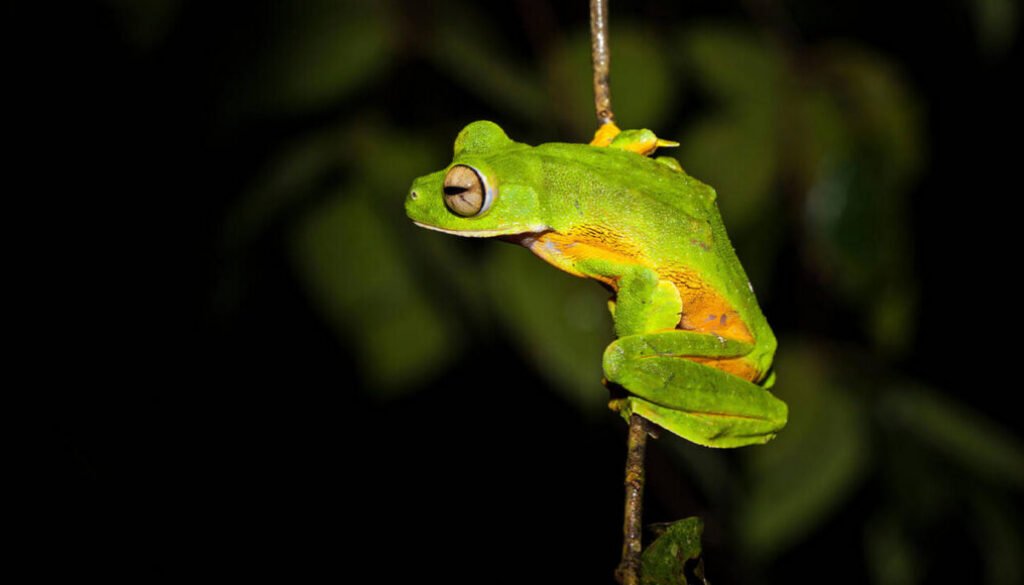
One of the most jaw-dropping facts about the Wallace’s Flying Frog is its ability to “fly.” While it doesn’t achieve powered flight like a bird, it is a master glider. By spreading its four limbs and stretching its oversized, heavily webbed feet, the frog creates a parachute-like surface. This allows it to glide from the high canopy to lower branches or the forest floor, covering distances of up to 15 meters in a single leap.
Essential Facts About the Wallace’s Flying Frog
-
Common Name: Wallace’s Flying Frog
-
Scientific Name: Rhacophorus nigropalmatus
-
Type: Amphibian
-
Diet: Insectivore (Crickets, flies, beetles)
-
Average Life Span in the Wild: 5 to 8 years in the wild
-
Size (Head and body): 9 to 10 cm (Head and body)
-
Weight: 40 to 100 grams
Engineering the Perfect Landing
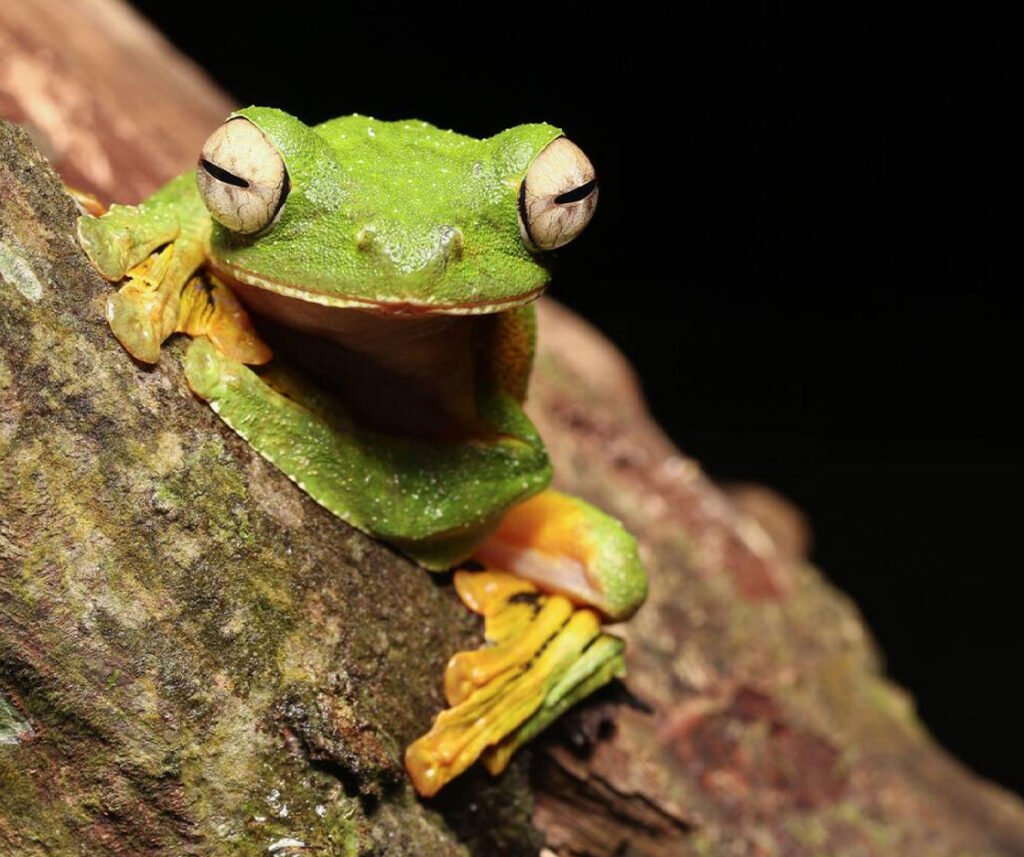
To survive a high-altitude glide, you need more than just wings—you need brakes. The facts about the Wallace’s Flying Frog show that its feet are equipped with large, specialized toe pads. These pads secrete a sticky mucus that creates a “suction” effect, allowing the frog to cling to smooth tropical leaves or slick bark immediately upon impact. This prevents them from bouncing off their target and falling into the jaws of ground-level predators.
A Vibrant Coat of Camouflage
At first glance, the bright green back of the Wallace’s Flying Frog seems like it would make it an easy target. However, in the dappled light of a tropical rainforest, this brilliant emerald hue mimics a sunlit leaf perfectly. The underbelly is often pale yellow or white, which helps it blend into the bright sky when viewed from below by aquatic predators. This dual-layer camouflage is a critical survival mechanism in a “eat or be eaten” environment.
The Giant Webbing Secret
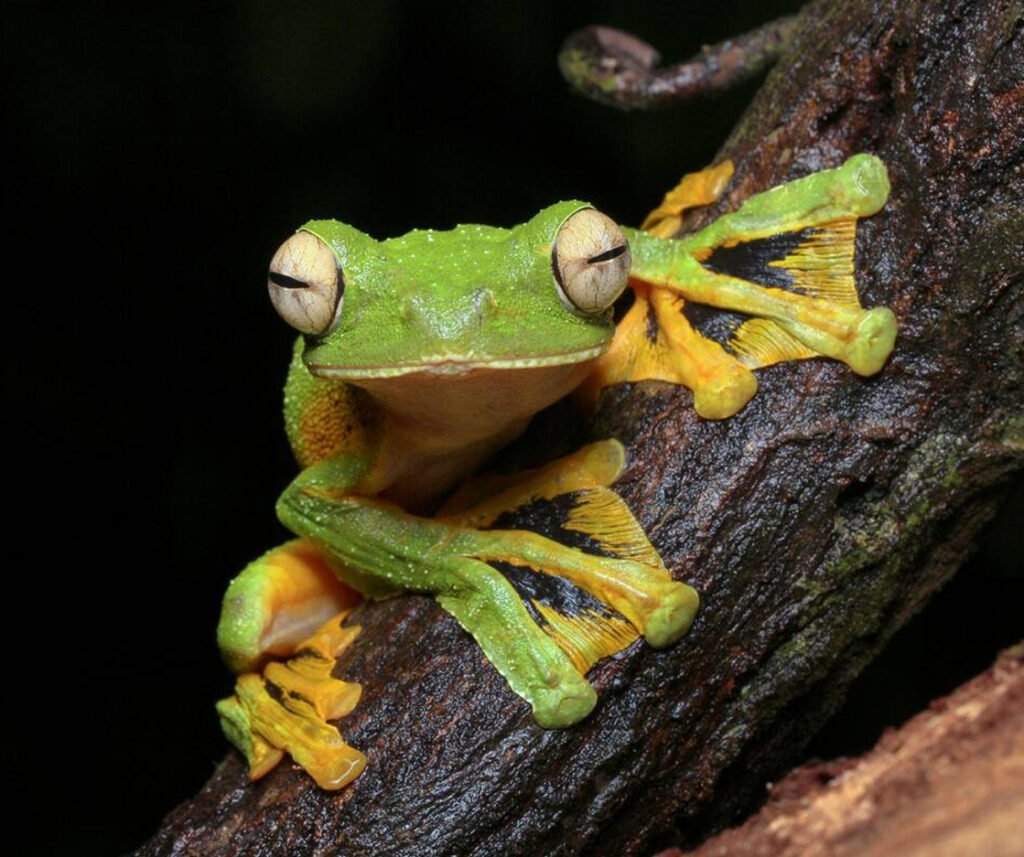
If you look closely at the webbing between its toes, you will notice it is jet black. This isn’t just for show. When the frog is tucked away resting, the black webbing is hidden. But when it leaps, the sudden flash of black and yellow beneath its limbs may momentarily startle a predator, giving the frog the split second it needs to glide to safety. Exploring facts about the Wallace’s Flying Frog reveals how every inch of its body is designed for tactical escape.
High-Altitude Nursery: The Foam Nest
Unlike most frogs that lay eggs directly in the water, Wallace’s Flying Frog prefers the penthouse suite. During the breeding season, the female produces a specialized fluid that she kicks into a thick, white foam using her hind legs. She attaches this “foam nest” to a branch hanging directly over a pond or slow-moving stream.
When the eggs hatch, the tadpoles drop straight out of the foam and fall into the water below to begin their aquatic stage. This clever strategy keeps the vulnerable eggs away from fish and other water-borne egg-eaters.
Alfred Russel Wallace’s Discovery
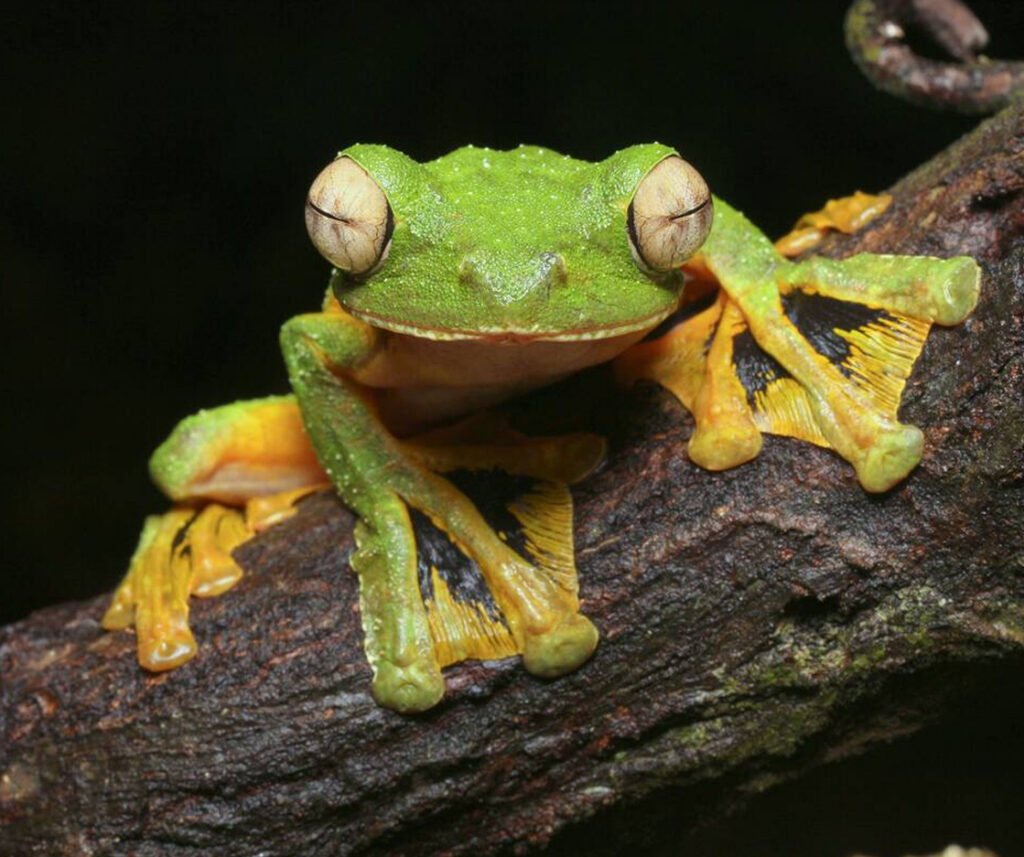
There are many historical facts about the Wallace’s Flying Frog that tie back to the foundations of biology. Alfred Russel Wallace, a contemporary of Charles Darwin, collected the first specimen in Borneo. He was so stunned by the oversized feet that he initially struggled to convince others that a frog could glide. His discovery helped highlight the incredible biodiversity of the Malay Archipelago and the creative ways species adapt to their specific niches.
A Strict Insectivorous Diet
To maintain the energy required for its acrobatic lifestyle, this frog is a voracious hunter. Its diet consists mainly of nocturnal insects. It uses its keen eyesight to spot movement in the dark, launching itself with precision to snatch crickets, moths, and beetles. By controlling the insect population, the Wallace’s Flying Frog plays a vital role in maintaining the ecological balance of the jungle canopy.