Why Are They Called the King Vultures?
Why are they called the king vultures? According to Mayan folklore, the king vultures got their name from their action. Whenever they landed at a feast, every other scavenging bird immediately parted ways, bowing to their absolute authority as a true king.
1. A Regal Visual Appearance
Surprisingly, when you look at them, the word “regal” feels entirely appropriate for a bird that feeds primarily on decaying animals.
-
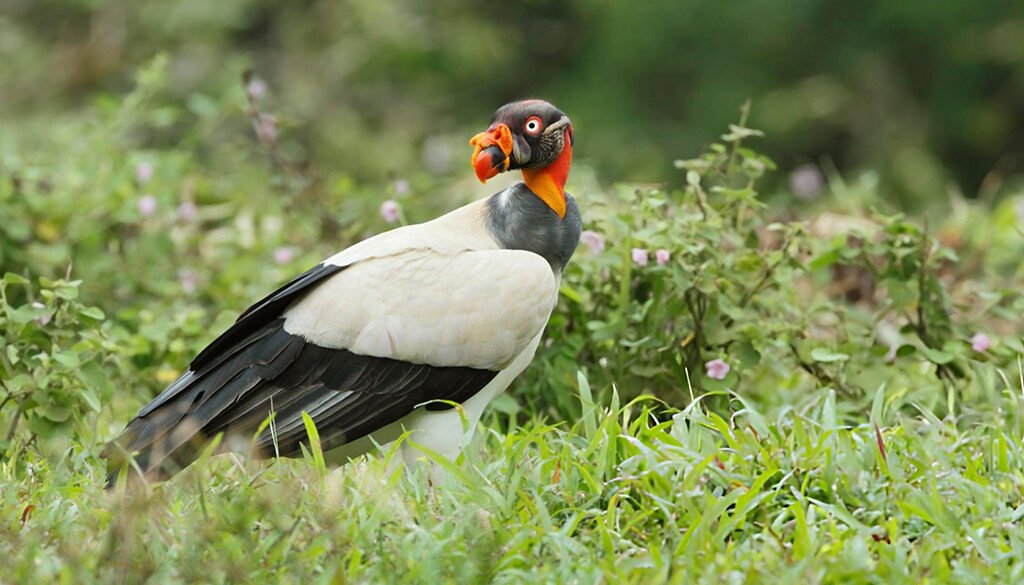
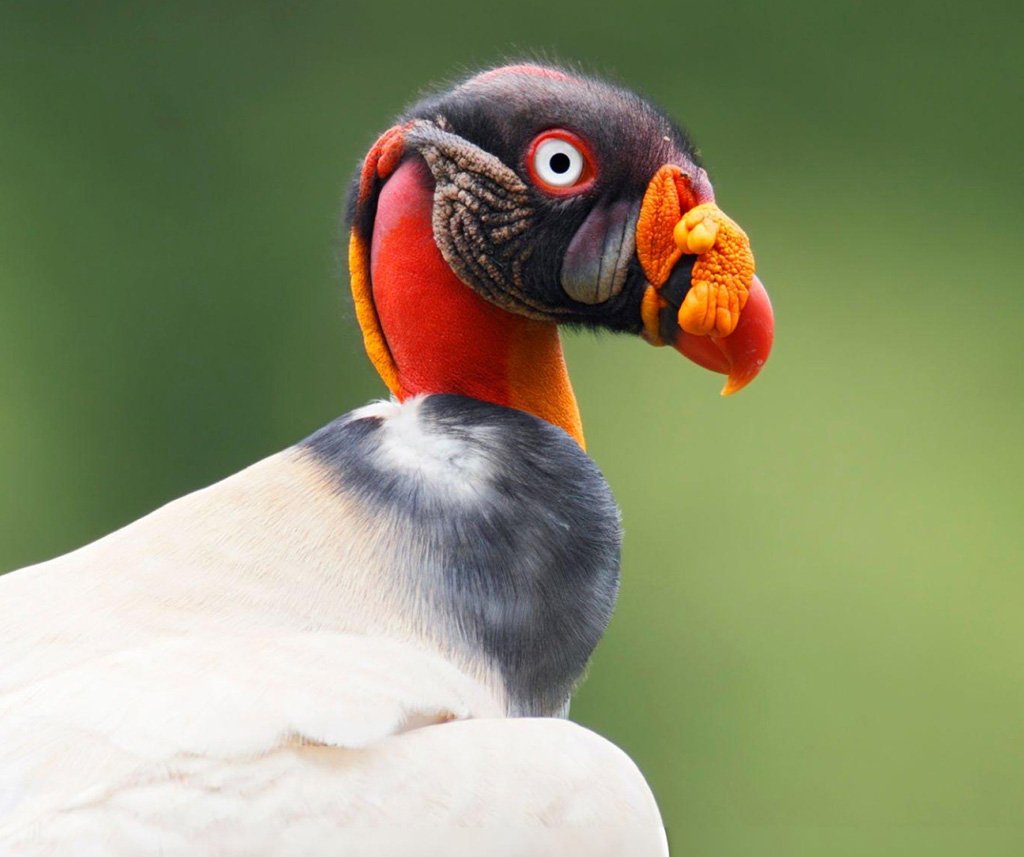
Striking Plumage: These birds boast a crisp cream-white body contrasted sharply by dark black flight feathers and a matching black tail.
-
Crown-Like Caruncle: Sitting atop their bill is a fleshy, bright orange or golden crest known as a caruncle. This distinct ornament resembles an ornate crown worn by ancient royalty.
-
Vibrant Head Coloration: Their featherless head—an evolutionary adaptation designed to maintain hygiene while feeding—blooms with vivid hues of bright orange, crimson, purple, and yellow.
-
Piercing Eyes: With stark white irises framed by vivid red rings, their gaze commands attention across the forest floor.
When perched high in the forest canopy, they look less like a simple scavenger and more like a mythical sovereign surveying its kingdom.
2. Behavioral Dominance at the Feast
Asking why are they called the king vultures brings you directly to their behavior at a carcass. Their royal status is not merely aesthetic; it is entirely functional.
When a feeding opportunity arises, a clear hierarchy unfolds among Neotropical scavengers:
Bird Species | Primary Role | Adaptation | Hierarchy Level |
Greater/Lesser Yellow-headed Vulture | Scent Finder | Acute olfaction to detect ethyl mercaptan gas | First on scene |
Turkey Vulture | Scent Finder / Surface Feeder | Sharp sense of smell, lighter beak | Locates carcass, feeds on soft tissue |
Black Vulture | Group Aggressor | Numbers and persistence | Surrounds carcass in flocks |
King Vulture | Hide Opener & Monarch | Massive hooked beak, heavy neck muscles | Claims absolute priority |
While turkey vultures excel at locating food through dense jungle canopy using their acute sense of smell, their beaks are often too weak to tear open the tough hides of large mammals. The king vulture possesses a powerful, hooked beak capable of tearing through thick skin. When the king arrives, smaller scavengers yield space, allowing the king to eat first while simultaneously opening up the carcass for the rest of the ecosystem.
3. Deep Roots in Mayan Mythology
Long before Western ornithologists assigned scientific names to Central American wildlife, indigenous cultures recognized the king vulture’s supreme status. In Mayan codices and stone carvings, the bird is frequently depicted as a deity or royal messenger.
-
Coded Representation: Mayan hieroglyphs depict the king vulture with its distinctive caruncle and prominent beak, often representing the god Cib or serving as a symbol of power and transition between life and death.
-
Linguistic Legacy: In several indigenous languages, the name for this species translates directly to “King of the Vultures” or “Chief Scavenger,” directly answering why are they called the king vultures across regional history.
4. Solitary Royalty and Nesting Habits
Unlike black vultures or turkey vultures, which often roost and feed in large groups, king vultures lead relatively solitary lives.
-
Social Structure: They are typically seen soaring alone or traveling in monogamous mated pairs.
-
Nesting Strategy: They construct no formal nests. Instead, a female lays a single white egg directly inside hollow tree trunks, stump cavities, or high rock crevices.
-
Parental Care: Both parents share incubation duties for roughly 55 to 60 days. Once hatched, the chick receives dedicated care for up to a full year.
5. The Maturation Process: Earning the Crown
A king vulture is not born with its royal colors. Juveniles spend their early years in dark brown or blackish plumage, easily mistaken for other vulture species from a distance.
It takes four to five years of gradual molting for a young king vulture to develop its full, brilliant white plumage and colorful head ornamentation. This multi-year transformation mirrors a prince slowly maturing into its crown before taking its place at the top of the feeding hierarchy.
6. Effortless Canopy Flight
Soaring high above the rainforest canopy on thermal updrafts, a king vulture can drift effortlessly for hours without flapping its wings. Their expansive wingspan (often exceeding 6 feet) provides high lift-to-drag ratios, allowing them to survey vast stretches of territory while conserving critical energy.
By keeping a watchful eye on smaller scavengers below, the king uses its height advantage to pinpoint exact feeding locations across miles of dense forest.
7. Vital Ecological Role
Beyond the folklore and striking visuals, the ultimate reason why are they called the king vultures lies in their ecological necessity. As primary scavengers capable of opening tough carcasses, they accelerate the decomposition process, preventing the spread of disease across tropical ecosystems.
They are true rulers of their domain—crowned by evolution, respected by competing scavengers, and essential to the health of the rainforest.